
1
We move the area first, to map exactly where the tissue stops sliding.
Services
If an old injury, a surgery, or years of the same motion left tissue that won’t slide, a tool can find it.
What It Is
Under your skin, muscle is supposed to glide over muscle, and tendon is supposed to slide inside its sheath. After a surgery, an old injury, or years of the same repeated motion, those layers can knit down and stop sliding. Stretching pulls on the whole chain and leaves the stuck part alone.
IASTM stands for instrument-assisted soft tissue mobilization. Dr. Moy uses a smooth, contoured tool, usually stainless steel, and glides it over lotioned skin along the restricted tissue and around old scars.
The tool does two things fingers can’t. It sends the gritty, ropey feel of a restriction straight back to his hand, so the exact edge of the problem gets found. And it concentrates pressure into a small, specific area instead of spreading it.
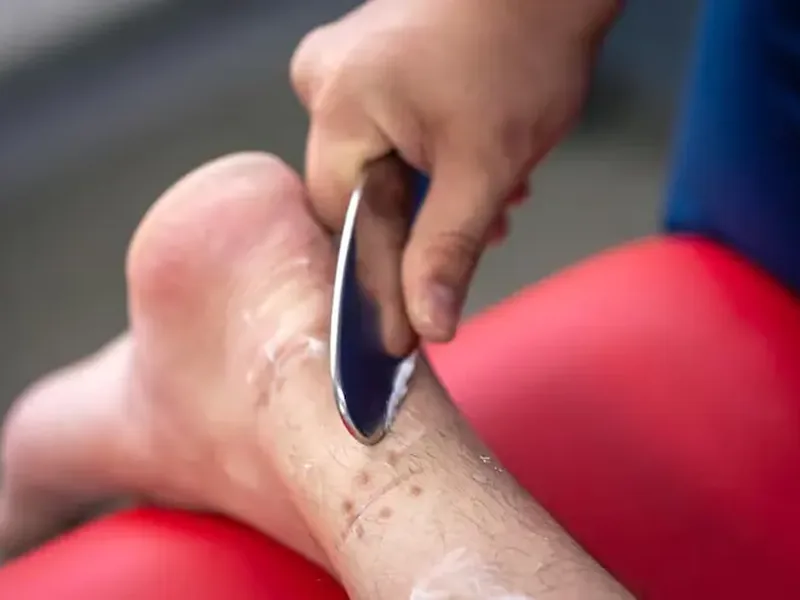 You set the pressure, start to finish
What It Helps
You got most of the way back after the injury, then settled there. Good enough is not the same as done.
What A Session Looks Like
1
We move the area first, to map exactly where the tissue stops sliding.
2
The tool looks intense. It glides on lotion, and you call the pressure the whole time.
3
Then you use the new range, same hour. Mild redness or soreness is normal after.
Why It Works
Restrictions you can feel start to give.
Movement that stops catching partway.
Old scars that stop pulling on you.
A stubborn spot that finally responds.
Questions, Answered
Your first visit starts with a cause-first evaluation, not a treatment off a menu. IASTM is used when the evaluation says it is the right tool for what is driving your symptoms, and it is delivered one-on-one with a Doctor of Physical Therapy for the full hour.
Amplify Physical Therapy and Wellness is in network with BCBS PPO and Medicare, and out of network with Aetna and United Healthcare. There is also a cash-based option with the price agreed up front. We check your benefits before your first visit so you know the cost before you commit.
Most patients feel meaningful change within 4 to 6 visits. Your plan moves through the four phases, Pain, Prime, Perform, and Prevent, so there is a defined endpoint rather than an open-ended run of appointments.
Book Your Visit
Request a time and a real person calls you back, usually within two business hours. No phone tree. No ‘someone will reach out.’ Just a plan.
5.0 · 60 Google reviews
Typical response: under 2 business hours
Step 1 of 5
That’s the hard part done. We’ll call during business hours to lock in your time. Most people are on the schedule same week.
Visit Us